AI-generated illustration; not a photograph of the reported event.
- calendar_today November 13, 2026
Practical MTA Projects with Potential Big Gains
While ambitious ideas for New York City transit often capture attention, the Metropolitan Transportation Authority (MTA) is also considering a range of modest projects that could yield significant benefits for everyday commuters. Drawing from the MTA's 2023 report, several lower-cost initiatives are being explored that aim to enhance service, reliability, and efficiency across the city’s transit network.
Ridgewood Busway: Bypassing Congested Streets
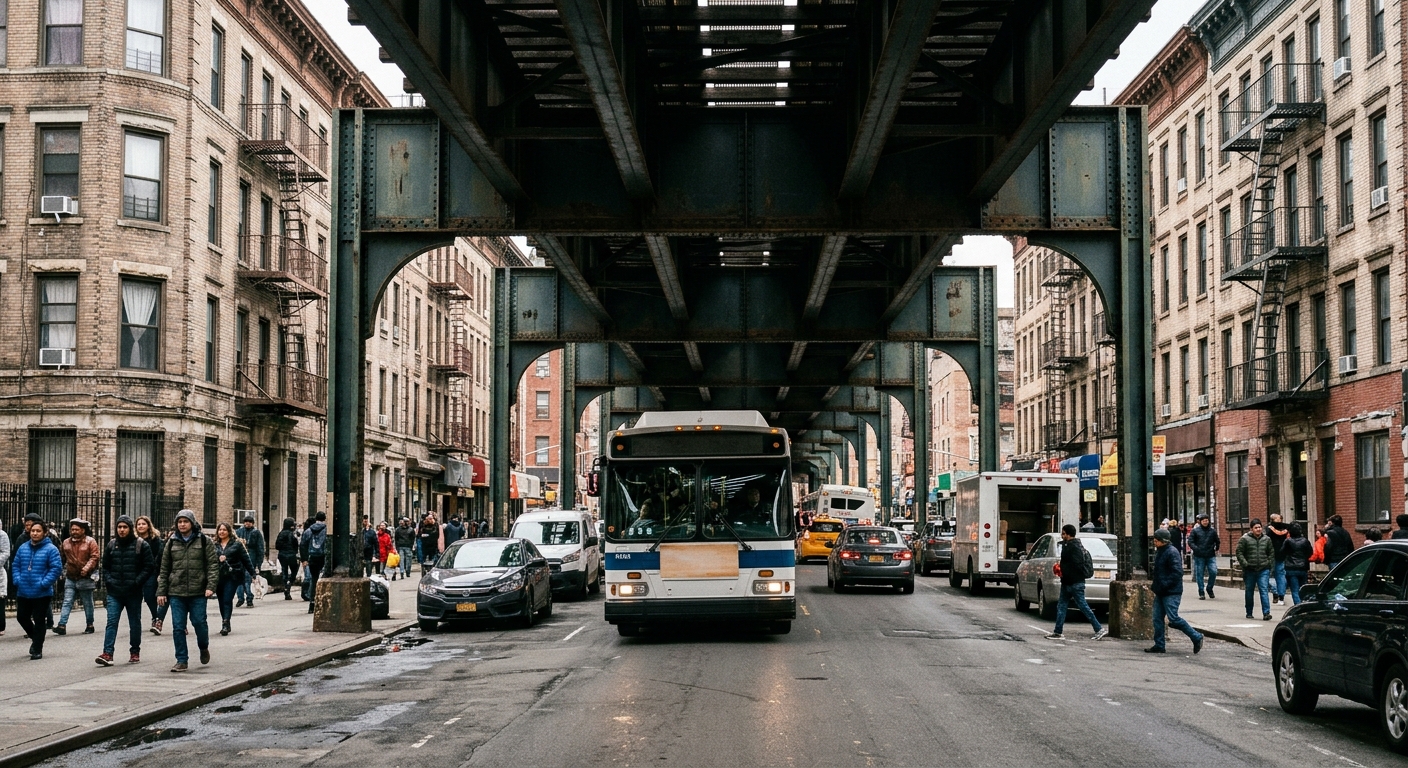
Among the proposed projects is a $30 million plan to construct a busway beneath the elevated M line tracks in Ridgewood, Queens. This half-mile, bus-only corridor would span from Palmetto Street and Onderdonk Avenue to Fresh Pond Road. The route is designed to allow multiple bus services to bypass gridlocked local streets, providing a "more reliable and operationally efficient" commute for thousands of riders. According to the MTA’s assessment, the Ridgewood busway is considered highly cost-effective due to its potential to reduce operational expenses while delivering improved service.
Restoring Elmhurst LIRR Station: A Debated Opportunity
Another option on the table is the restoration of the Long Island Rail Road (LIRR) station in Elmhurst, Queens. Demolished in the 1980s, the station's rebuilding is estimated to cost $210 million. The project aims to entice riders away from crowded subway lines by giving the neighborhood a commuter rail connection directly to Manhattan. The MTA has described the potential benefits as “marginal” for an area already well served by transit, but U.S. Rep. Grace Meng, representing Elmhurst, believes the estimate fails to account for local population growth and increased demand for commuter rail options. Meng argues that a new station would support mass transit usage and offer a 10-minute commute to destinations like Penn Station or Grand Central Terminal.
Addressing Subway Bottlenecks
In addition to these projects, the MTA is working on reducing subway congestion by targeting bottlenecks throughout the system. A summer 2023 plan highlights efforts to alleviate strain at major choke points including two in Brooklyn. Addressing the bottleneck at Nostrand Avenue alone is projected to cost $410 million. These targeted fixes are intended to reduce delays and improve overall subway efficiency for regular riders.
Support for Smaller Investments
Advocates for practical transit improvements, including Liam Blank, chair of the City Club of New York transportation and infrastructure committee, emphasize the value of pursuing smaller capital projects such as busways. Blank comments that "busway implementation is probably at the highest feasibility" due to cooperative city and MTA leadership, calling such projects “low-hanging fruit” for enhancing NYC’s transit landscape.
Other NYC Transportation Updates
- The Department of Transportation is using plastic bollards to reduce car traffic near McGolrick Park in north Brooklyn, part of a broader effort to design low-traffic neighborhoods.
- Analysis has revealed that sanitation supervisors with the NYC Department of Sanitation accumulate hundreds of automated speed camera tickets each year while overseeing trash collection.
- New research links teen boys diagnosed with ADHD to the dangerous subway “surfing” trend, highlighting ongoing safety concerns.
- The Reimagining Canal Street project in Manhattan is moving forward in phases, aiming to add new crosswalks, bike lanes, and pedestrian areas.
- Construction is underway on a replacement for the Newark Bay Bridge, set for completion by 2031 and designed to minimize disruption for commuters between New Jersey and New York City.
- A federal plan to rebuild Penn Station may also result in significant taxpayer funding for a new Madison Square Garden Company entertainment venue.
- MTA Chair Janno Lieber expressed optimism that a Democratic majority in Congress will improve funding prospects for existing transit projects.
- A tragic incident occurred on the Brooklyn-Queens Expressway, where a woman was killed after falling from a moving vehicle.
Transit Curiosities: Graffiti on Subway Trains
Reader questions reveal ongoing interest in the evolution of NYC transit. In response to a question about subway graffiti, it was noted that the MTA introduced a policy in 1989 to pull any graffitied train from service immediately—a move that ultimately curbed the presence of graffiti on subway cars. Trains are still thoroughly cleaned before re-entering service if graffiti is discovered.
Source: gothamist.com.