- calendar_today August 11, 2025
Locally, New York has positioned itself as a national leader in clean energy. Under the Climate Leadership and Community Protection Act (CLCPA), the state aims to derive 70% of electricity from renewables by 2030 and reach zero-emission electricity by 2040. Yet, as national stocks slump, the region’s green energy ambitions face significant market resistance.
Green Energy Stocks: A Market in Transition
Several leading green energy companies have seen stock prices tumble in early 2025. Tesla (TSLA), which maintains a strong EV infrastructure footprint in New York City and surrounding metro areas, saw a 45% decline year-to-date after weak vehicle deliveries—336,681 units in Q1, the lowest in two years.
Meanwhile, solar giants like First Solar (FSLR) and Enphase Energy (ENPH) have also struggled. First Solar’s value is down over 30%, despite reporting $4.2 billion in sales for 2024. Enphase has dipped 29%, even after expanding its solar battery products into international markets.
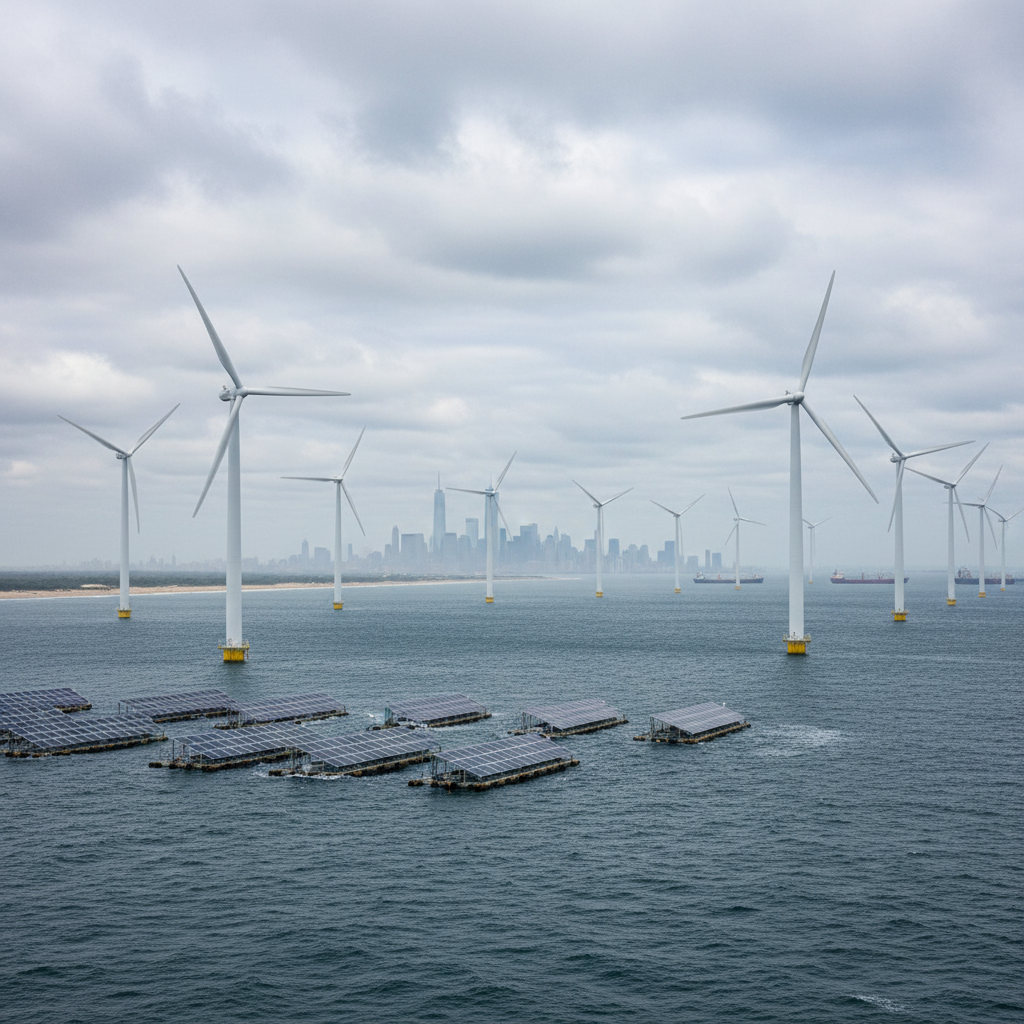
Closer to home, New York’s utility-scale solar projects and offshore wind initiatives—such as Empire Wind and Sunrise Wind—have faced rising development costs and grid integration delays, reflecting broader investor concern about project profitability and execution.
Policy Support: New York Climate Law Meets the Federal IRA
Federal support under the Inflation Reduction Act continues to bolster clean energy nationwide, with tax credits such as the ITC (30% for solar/wind projects) and the PTC ($0.0275 per kWh of renewable output). These incentives are especially valuable in states like New York, where aggressive climate laws are driving rapid clean energy deployment.
New York State’s own initiatives complement these federal policies. The NY-Sun program, administered by NYSERDA, aims to make solar accessible to over 700,000 New York households by 2030. Meanwhile, the state’s Green Bank continues to finance clean energy and energy efficiency projects in underserved areas.
However, looming political risks could shift this trajectory. National-level proposals under initiatives like Project 2025 seek to roll back clean energy commitments and worker protections. Any rollback could directly affect federal-state synergy on renewable expansion in New York.
Macroeconomic Conditions: Local Impacts of National Trends
From a macroeconomic standpoint, high interest rates and uncertain consumer demand present challenges. The Federal Reserve has maintained rates between 4.25–4.5% in 2025, a level that’s proving difficult for capital-intensive renewable energy sectors.
New York’s clean energy developers—especially those building offshore wind and battery storage facilities—are particularly exposed. Long construction timelines and substantial upfront costs make borrowing expensive, potentially delaying project timelines.
Still, inflation has cooled. As of March 2025, national inflation dropped to 2.8%, down from 3.1% in January. Lower inflation may boost state and municipal budgets, paving the way for additional infrastructure investments—including the modernization of New York’s aging grid.
ETF Performance: Sector Trends for New York Investors
Two of the top clean energy ETFs—iShares Global Clean Energy ETF (ICLN) and First Trust Clean Edge Green Energy ETF (QCLN)—are widely held by retail and institutional investors in New York.
- ICLN has recorded a modest year-to-date drop of over 5%.
- QCLN has seen a steeper decline of nearly 28% as of early April.
These ETFs mirror losses in key holdings such as Enphase and First Solar. However, many New York-based financial advisors continue to recommend them as long-term plays, given their diversification and potential for rebound.
In fact, over a five-year span, both funds have generated double-digit returns—suggesting that despite near-term volatility, long-term prospects remain strong for climate-focused portfolios.
What Analysts Are Saying
Opinions in financial circles are divided, particularly among New York analysts managing climate-tech portfolios.
“The underlying fundamentals remain sound, especially in regions like New York with aggressive clean energy targets,” said Samantha Klein, an energy analyst at Morningstar. “But volatility will persist until we get more policy clarity post-election.”
Goldman Sachs, on the other hand, downgraded its clean energy outlook for Q2 2025, citing global solar supply chain oversaturation and the rising cost of grid modernization—issues that directly impact New York’s large-scale wind and solar ambitions.
Still, the International Energy Agency (IEA) projects renewables will account for 42% of U.S. electricity by 2030, with New York playing a key leadership role thanks to its urban EV transition plans and coastal wind resources.
So, Should You Invest Now?
Whether or not to invest in green energy stocks in New York in 2025 depends largely on your time horizon and risk appetite.
- Long-term investors (5–10 years) may find today’s prices appealing, especially given New York’s alignment with national clean energy goals and continued investment in grid upgrades and offshore wind.
- Short-term traders or cautious investors may want to hold back, as political uncertainty and high interest rates create turbulence that’s hard to time.
As always, diversification is essential. Rather than choosing individual stocks, many New York-based investors are opting for ETFs like ICLN or QCLN to reduce risk exposure across the solar, wind, EV, and battery storage sectors.
In 2025, green energy is no longer a niche sector—it’s a central part of New York’s economic and environmental strategy. While short-term volatility may rattle investors, the long-term trajectory is supported by both state policy and global climate priorities.
The ultimate question is not just “Are green energy stocks a buy?”—but rather, “What kind of investor are you?” and “Can you ride out the storm?”
Want more region-specific investment analysis? Subscribe to our newsletter for weekly updates on New York’s energy markets, policy developments, and financial opportunities.