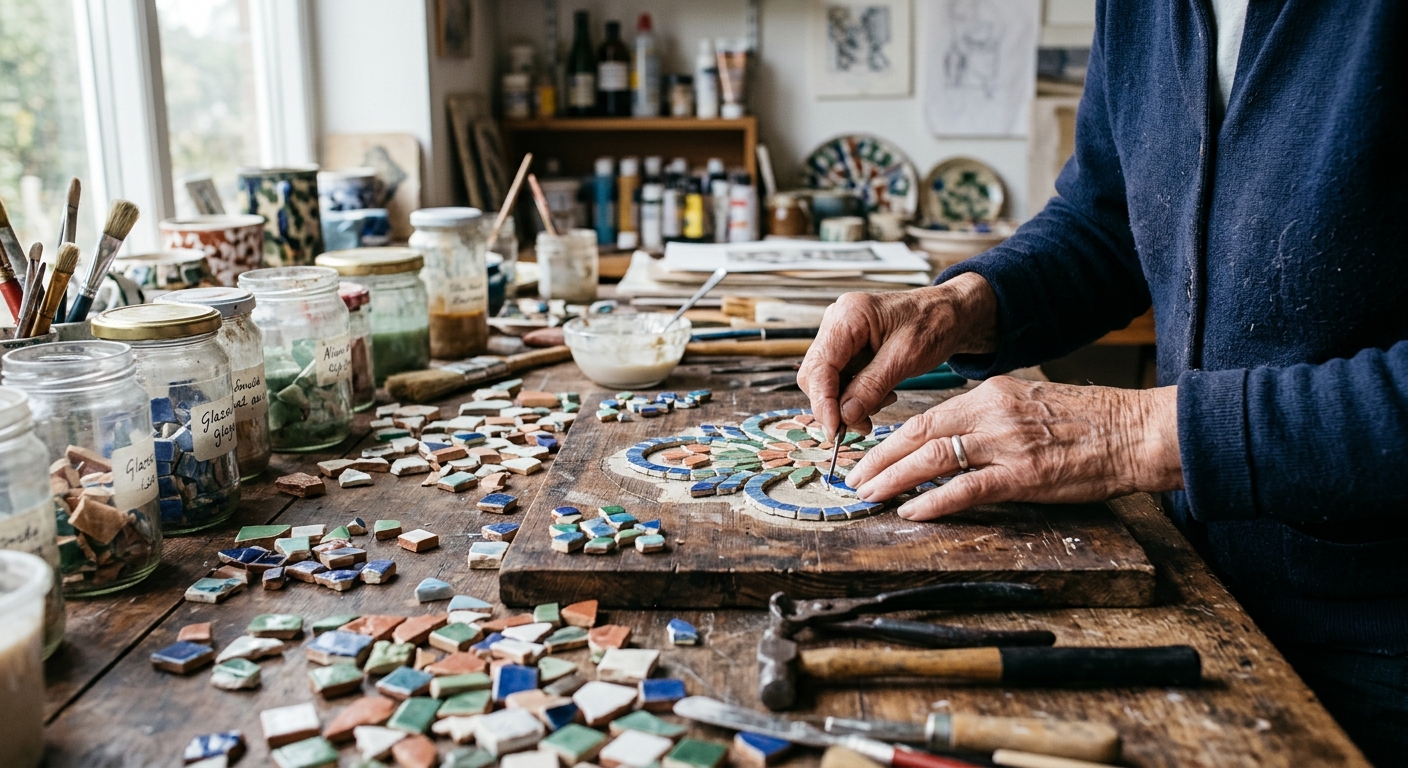
AI-generated illustration; not a photograph of the reported event.
- calendar_today November 16, 2026
The Sole Steward of MTA Subway Mosaics
Every time a colorful mosaic sign at a New York City subway station—such as those at Columbus Circle or Cortlandt Street—needs replacing, the Metropolitan Transportation Authority (MTA) turns to just one specialist: Robert Shenfeld. Operating from his studio in Syracuse, Shenfeld, 73, is regarded as the only master capable of restoring and replicating the storied tile mosaics integral to the city’s subway system.
A Singular Skillset and a Studio in Syracuse
Shenfeld’s workshop, located 250 miles north of New York City, employs a dedicated team of artists. Despite working far from the bustle of the subway system, this team is responsible for producing and restoring tiles that feature in both subway stations and other public projects, such as the Hansborough Pool in Harlem. The process is labor-intensive and so detailed that deadlines sometimes stretch, but both Shenfeld and the MTA acknowledge that the quality cannot be rushed.
Monopoly Born of Experience and Equipment
Shenfeld’s path to his unique monopoly on MTA subway mosaics began in 2008 when he bought the tile-making equipment from the previous contractor. Today, the workshop is said to be the only studio globally that can precisely recreate the intricate designs and colors found throughout the subway system. According to Jamie Torres-Springer, MTA’s head of construction, the agency has little option but to rely on Shenfeld, balancing their desire for faster, cheaper work against the necessity for quality and accuracy.
Projects Across the Boroughs
Since establishing his studio, Shenfeld has overseen mosaic restorations at 50 subway stations, including the major renovation at Brooklyn’s Borough Hall—the largest effort of his career. Current restoration projects are underway at stations such as 14th Street Union Square, Jamaica-Van Wyck in Queens, and Parkchester in the Bronx. In cases where mosaic installations were delayed, the MTA had to install posters until Shenfeld’s completed works arrived.
The Art and Challenge of Perfect Replication
Reproducing mosaics involves extensive color testing and a hands-on approach. For the Borough Hall project, Shenfeld and his team conducted more than 300 color tests to match 60 distinct hues, an effort made more difficult by modern safety standards that forbid the use of original lead-based glazes. Moreover, the scarcity and cost of certain minerals, such as lithium and silica—which are needed for achieving specific textures and matte finishes—add to the complexity.
Artisans Behind the Tiles
Shenfeld is joined by artists like John Das, who joined the studio after coming to the US as part of a Nepali resettlement program. Das was primarily responsible for the color matching on the Borough Hall mosaic, assisted by his family and working from century-old reference images to reconstruct mosaics as they appeared in 1908.
Looking Forward Amid Uncertainty
Despite his age, Shenfeld is not ready to retire, a prospect that is a cause for concern among MTA leaders due to the lack of alternative specialists. As Shenfeld put it, “You know I’m 73, I might retire, but I don't think so. What would you do? And he goes, ‘You're not retiring.’” For now, the future of NYC’s subway mosaics remains tied to this Syracuse studio and its unmatched expertise in mta subway mosaics and subway tile restoration.
Source: gothamist.com.