- calendar_today August 14, 2025
.
Electric vehicle sales in the United States are sputtering in the face of new headwinds. After a year and a half of consistent monthly growth, EV sales have started to decline. Automakers such as Genesis and Volvo have already had customers walk away from their EVs, with both brands currently evaluating whether to adjust their offerings in response.
Political pressures have further muddied the waters. The Biden administration has reduced subsidies and eliminated vehicle emissions rules, removing several federal purchasing incentives for drivers. But according to market analysts, the biggest hurdle to EV adoption may already be parked in America’s driveways.
Level 2, Where You Park
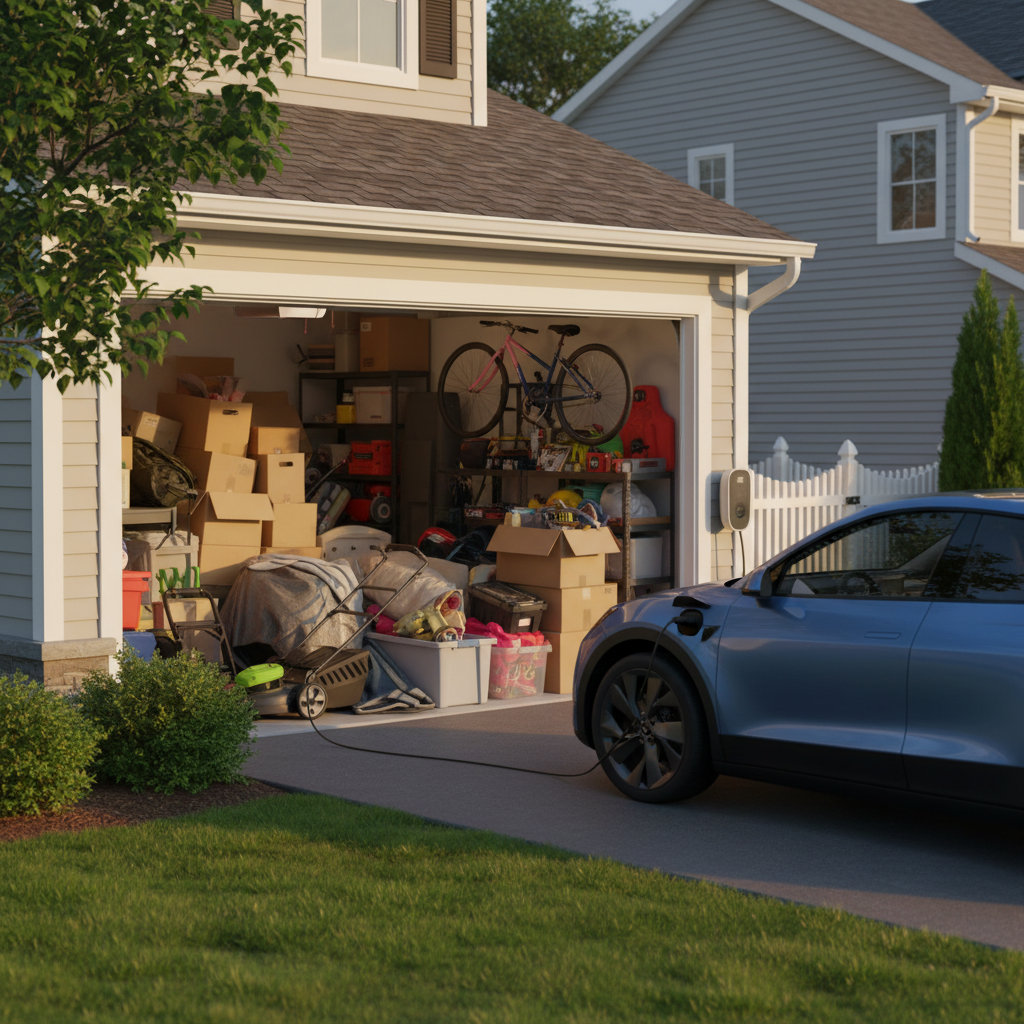
Consumer surveys have long identified range anxiety over charging as a primary barrier to electric vehicle adoption. In a new study, Telemetry Vice President Sam Abuelsamid takes a deeper dive into this concern, uncovering a less-discussed issue: garage use.
Despite increasing media attention on fast-charging infrastructure, most EV charging still takes place at home. An estimated 80 percent of all EV charging is done with AC power, and most of that is at a single-family residence. The National Renewable Energy Laboratory (NREL) recently found that 42 percent of homeowners already have space to park near an outlet that can support level 2 (240 volt) charging.
This share could rise significantly, to 68 percent, if homeowners cleared their garages of clutter and shifted their parking habits. “90 percent of all houses can add a 240 V outlet near where cars could be parked,” says Abuelsamid. “Parking behavior, namely whether homeowners use a private garage for parking or storage, will likely become a key factor in EV adoption.”
By Abuelsamid’s calculations, if more garages were repurposed for cars instead of storage, the number of homes capable of EV charging would rise from 31 million to over 50 million. Including homes that could install new wiring, that total could reach more than 72 million. This number would surpass even Telemetry’s most bullish EV penetration projections for 2035, which range from 33 million to 57 million vehicles.
The Barriers to Charging
Capacity on paper, however, does not translate into readiness on the ground. NREL also found that nearly 34 million homes would need expensive electrical system upgrades to support a level 2 charger, which requires at least 30 amps of power. These electrical updates, which can range from new wiring to full panel replacements, can cost homeowners thousands of dollars.
In practice, this may undercut one of EVs’ main selling points: lower lifetime cost compared to a gas-powered vehicle. When the installation of charging equipment is included in the purchase price, the total cost of ownership can quickly approach or even exceed that of a conventional car.
Parking Lot Battles
The situation is even more challenging for the 23 percent of Americans who live in multifamily buildings such as apartments, condos, and townhomes. In these cases, individual EV owners often do not have the right to install chargers. Instead, they must seek permission from landlords, management companies, or co-op boards, an approval which is by no means assured.
Financial barriers are also greater. Renting a co-op a pair of shared level 2 chargers, for example, may first require a full electrical panel upgrade. This project can cost millions. Wiring additional distances for remote parking spots creates more costs. Unlike homeowners, these residents are often ineligible for municipal or utility incentives for charger installation.
Currently, about one million EV drivers live in multifamily housing, but only 11 percent of them park near enough an outlet to charge. Some states have taken steps to require 20–25 percent of parking spots in new developments to be EV ready, but even these mandates will only increase the number of charging-capable spaces in multifamily dwellings to a projected 6.7 million to 11.4 million by 2035, according to Telemetry. This total falls short of expected demand.
Public Charging Infrastructure
Home charging is not the whole story, however, and public infrastructure will be critical. Telemetry forecasts that between 11.7 million and 14.3 million EV drivers that own houses will still make use of public charging in 2035. Another 7.8 million to 8.1 million EV drivers living in multifamily residences will also need public chargers.
Demand for public charging will require between 523,000 and 586,000 DC fast chargers, and an additional 1.5 million to 1.6 million level 2 chargers nationally. Expanding that capacity, however, is not without its own complications. Local power companies are already strained, with new AI data centers vying for new generation and distribution capacity as they set up shop, adding another layer of complexity to large-scale charging site construction.
Looking Forward
Despite the headwinds, enthusiasm for electric vehicles remains high, but the U.S. EV transition story is not as simple as it looks. While tens of millions of homes could in theory support EV charging, cluttered garages, high electrical upgrade costs, and the challenges of multifamily living loom as serious threats to adoption. Even an ambitious expansion of public charging capacity may not fully meet demand over the next decade.
For now, one thing is certain: the future of electric vehicles in America may well depend as much on what’s in homeowners’ garages as it does on government policy or automakers’ plans.