- calendar_today August 24, 2025
Why The Sandman’s Second Season Is the Perfect Farewell
Netflix’s lushly visualized series adaptation of Neil Gaiman’s iconic graphic novel series The Sandman is wrapping up with the drop of its second and final season. Season 1 of the Sandman proved that the right team was in place to do justice to the hallucinatory, nightmarish atmosphere of Gaiman’s work, and viewers who have fallen in love with Dream’s (or Morpheus’) crew in Season 1 will be pleased with Season 2’s further adventures. The series, true to the source material, has an anthology-style tone while also being grounded by its overarching focus on Morpheus’ arc.
Netflix’s announcement in January that the series would conclude with Season 2 of The Sandman sparked rumors that its cancellations were tied to allegations of sexual misconduct against Gaiman, for which he was never charged. The series creator has also specifically denied the allegations. Showrunner Allan Heinberg gave a clear answer on X (formerly Twitter) to a fan’s question, explaining that they had always intended for the series to be two seasons long. Heinberg had said, “It is two seasons, and in the world of TV, that means it can come back, but in all likelihood it will not. We looked at the amount of story in The Sandman and felt we could tell what we wanted to tell in two seasons, and it would be a satisfying place to end for Dream’s story. We stand by that decision and the finished story.”
Season 1 adapted Preludes and Nocturnes and The Doll’s House, with two bonus episodes (“Dream of a Thousand Cats” and “Calliope,” both from Dream Country). Season 2 is the story of The Kindly Ones, drawing the most from Seasons of Mists, Brief Lives, The Kindly Ones, and The Wake; “The Song of Orpheus” and elements of “Thermidor” from Fables and Reflections; and the award-winning comic “A Midsummer Night’s Dream” from Dream Country. Bonus episode “The Long Road North” adapts the 1993 one-shot spinoff Death: The High Cost of Living. The series left out the events of A Game of You and some of the one-shot stories, but the omissions of these short stories did not cause the loss of any key threads from the main narrative of the Dream King.
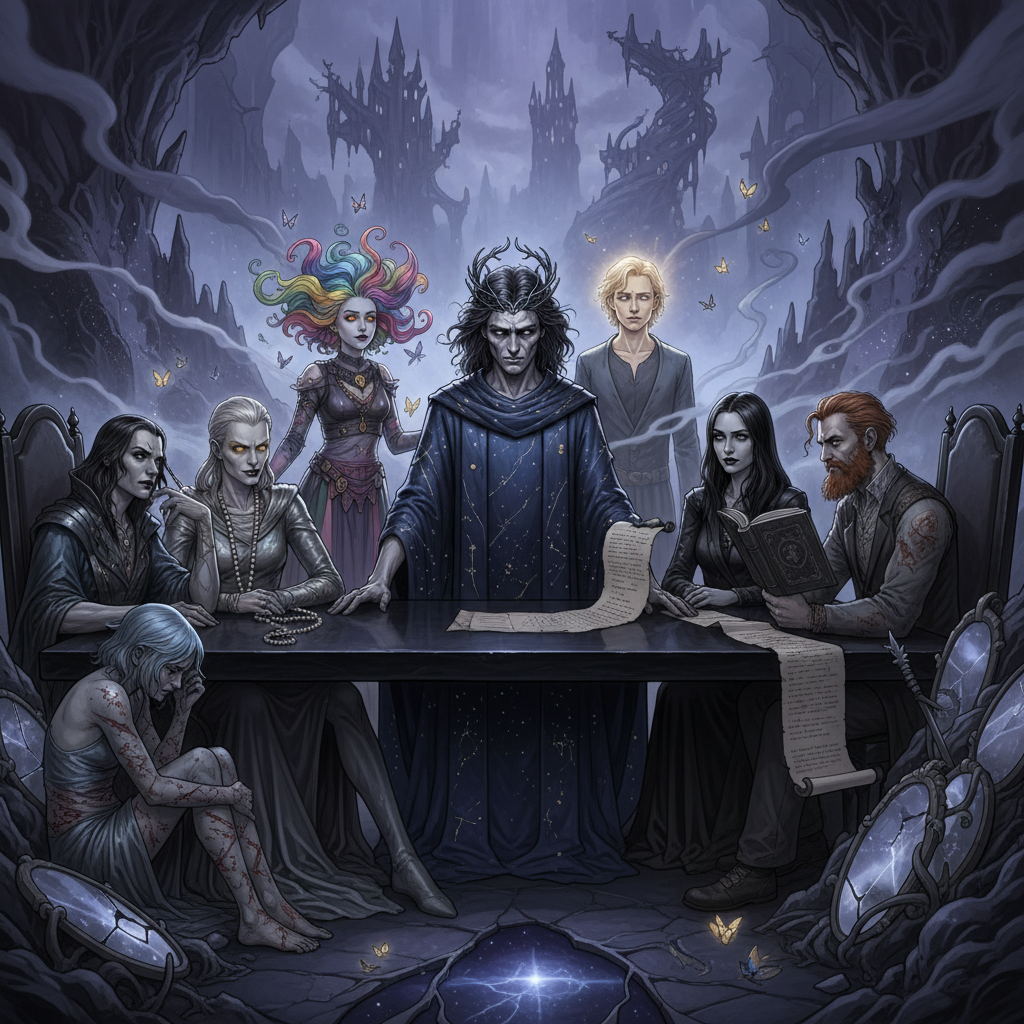
Morpheus (Tom Sturridge) has put Humpty Dumpty’s egg-shell world back together and re-established his Court after winning Season 1’s climax: he escaped the Bride of its long imprisonment, recovered his talismans, made peace with the rogue Corinthian (Boyd Holbrook) of Endless-killings past, and reconciled the Dreaming’s relationship with the Vortex during a new crisis. But he’s still focused on world-building when he gets the rare summons from his sibling and sister-in-law, Destiny (Adrian Lester) and Delirium (Esmé Creed-Miles), to meet with fellow Endless Death (Kirby Howell-Baptiste), Desire (Mason Alexander Park), and Despair (Donna Preston) in what quickly devolves into a tense, obligatory family meeting.
The summoned siblings decide Dream must save Nada (Umulisa Gahiga), the queen of the First People and Dream’s ex-lover, from Hell, which Dream had condemned her to centuries ago; this compels Dream to force another reckoning with Lucifer (Gwendolyn Christie), the demonic ruler of Hell, who is still stewing over her Season 1 defeat. But Lucifer surprises Dream by handing her the reins to Dream, complete with the key to an empty Hell, and says she’s resigning because “They never appreciated me here.” Lucifer names a list of candidates for Dream to interview for the position, including Odin, Order, Chaos, and a demon called Azazel. Later, Delirium confides in her sister that she and the others still yearn for their missing brother, Destruction (Barry Sloane), who left his Endless realm to walk the Earth centuries ago. Destruction’s chosen path and Delirium’s longing will inexorably drive Morpheus to his end and incur the wrath of the Kindly Ones.
High (Points) and Lowlights; Finale Summary and Verdict
Series production values remain consistently high, with stellar casting and a visual aesthetic that matches or betters the source material’s tableau of imagination. Some viewers have described the pacing as slow; it is still a deliberate choice in this season, as it was in the first, and invites immersion into Gaiman’s vision.
The weakest episode, for me, was “Time and Night,” in which Dream asks Time (Rufus Sewell) and Night (Tanya Moodie), Morpheus and Lucienne’s parents, to intercede with Destiny. The Endless are indeed their children, but aside from Rufus Sewell’s presence, these scenes are odd: the dialogue is stiff and wordy in a way that makes even excellent dialogue seem uninteresting, and the interaction is not dynamic enough to overcome the appearance of a Sisyphean therapy session with the two anthropomorphized beings of Time and Night.