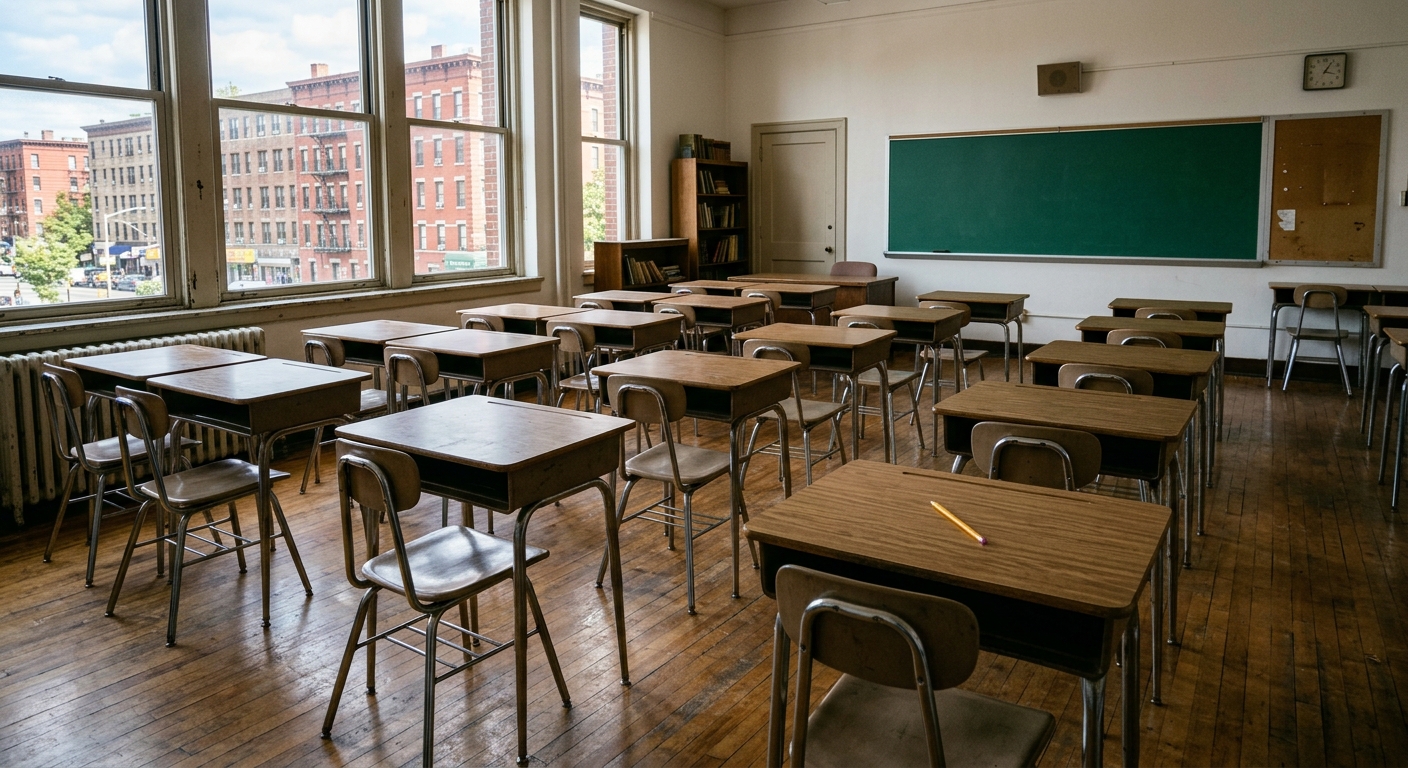
AI-generated illustration; not a photograph of the reported event.
- calendar_today November 27, 2026
NYC Public Schools: A Complex System Facing Persistent Gaps
As middle and high school application deadlines approach in New York City, families are navigating a stressful, intricate process that many say exacerbates existing educational inequities. With nearly 1,800 schools, NYC boasts the largest—and among the most segregated—school systems in the United States. Despite policy efforts, significant achievement and opportunity gaps remain.
Enrolling Fewer, More Disadvantaged Students
Public school enrollment in New York City has steadily declined, dropping 9% since 2016. The decline is most dramatic among Black students, whose enrollment fell by 22% over the past decade, compared to a 15% decrease for white students. The proportion of low-income students has grown: in 2016, they made up 71% of the population; today, that figure is 73%, as economic pressures such as rising rents push families away.
According to a 2026 study by Available to All, NYC remains the most segregated school system in the country. Accelerating Black student enrollment decline especially impacts majority Black schools, as funding tied to enrollment dwindles, leaving fewer resources for the remaining students. School closures due to under-enrollment are more likely to affect low-income, Black, and Latino communities.
Growth and Gaps in Early Childhood Education
Amid overall shrinking enrollment, 3-K participation has grown 13% since 2021, despite a slight dip in pre-K enrollment for 4-year-olds. Not all communities access early education equally: Pre-K participation has increased among Asian, Pacific Islander, Latino, white, and economically disadvantaged families, but fewer Black students are enrolling. Rising costs and families leaving the city contribute to this trend. In response, the Mamdani administration expanded the 3-K program citywide, adding 2,000 seats to address disparities.
Enduring Achievement Gaps in Standardized Test Scores
Standardized state assessments for grades 3–8 continue to reveal significant divides. In 2026, white elementary students had English Language Arts pass rates 25 points higher than Black students and 30 points higher than Latino students. Education experts say these achievement gaps are persistent and unlikely to close quickly without systemic reforms addressing poverty and structural inequities. Yet, officials cite improving eighth-grade test scores among Latino and Black students as a sign of modest progress.
Admissions Processes Fuel Opportunity Gaps
Admissions to middle and high schools in NYC are complex and competitive, fueling disparities. For middle schools, Latino and Black students were most likely to receive offers from one of their top three preferences (96–97%), compared to 88% of Asian and Pacific Islander students and 92% of white students in 2026. Low-income students fared slightly better than their more affluent peers.
High school admissions are more challenging for low-income families: only 73% of students living in poverty matched with one of their top three high schools, compared to 85% of students from more affluent households. Asian and Pacific Islander students again had the lowest rate among racial groups at 69%, reflecting a higher tendency to apply to selective programs. The demanding application process—including lotteries, academic tiers, essays, portfolios, and auditions—can disadvantage working-class families who may lack resources for exhaustive school research and application preparation.
Gifted and Talented Programs and Specialized High Schools
The disparities are even more notable in admission to gifted and talented (G&T) programs and the city’s eight specialized high schools. The five elite G&T schools attract more white and affluent students, with over 94% of their students meeting or exceeding English standards and over 96% excelling in math in 2026. Moves to phase out G&T programs have stalled despite calls for reform.
Specialized high schools remain highly exclusive: in 2026, 26,000 students vied for 4,000 seats via the SHSAT. Black students represented 17% of test-takers but received just 3.5% of offers. Stuyvesant High School, for instance, accepted only three Black students that year. The education department does not release socioeconomic data for specialized high school admissions, but racial disparities persist despite discussions on reforming the admissions process.
AP Exams and Graduation Rates Reflect Systemic Divides
Advanced Placement (AP) exam pass rates and graduation statistics mirror these divides. In 2025, students from low-income backgrounds had a 58% AP pass rate, compared to 75% for more affluent students. Black, Latino, and economically disadvantaged students were less likely to pass AP exams than their white and Asian peers.
Graduation rates likewise reveal persistent gaps: in 2025, Asian and Pacific Islander students had a 92% graduation rate, while Latino students trailed at 77%. Since 2021, progress in raising graduation rates has been limited, and disparities for Latino, Black, and low-income students have widened, especially following the pandemic. Still, all student groups have seen improvements compared to 20 years ago.
Looking Forward
While city officials point to strategic investments in literacy and math as beginning to move the needle, closing entrenched achievement gaps in NYC public schools remains a long-term challenge. Educational leaders say systemic change requires more than policy tweaks—it demands addressing underlying social and economic disparities that shape students’ opportunities from their earliest years.
Related coverage
Source: gothamist.com.