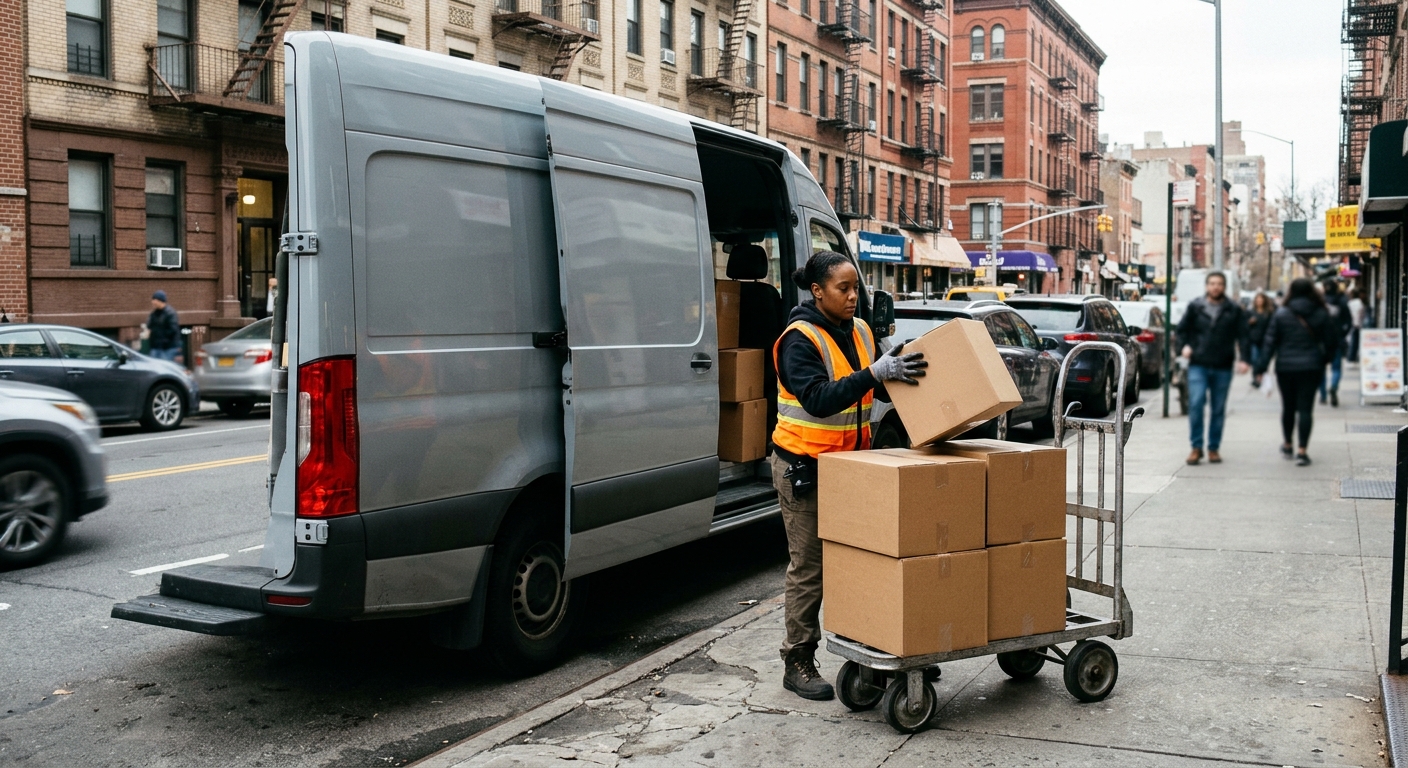
AI-generated illustration; not a photograph of the reported event.
- calendar_today November 17, 2026
NYC Council Considers Major Shift for Amazon Delivery Workers
The New York City Council is advancing legislation that could dramatically change how Amazon deliveries reach New Yorkers’ doorsteps, igniting a heated battle involving the tech giant, third-party contractors, labor unions, and small businesses.
Current System: Third-Party Contractors Deliver for Amazon
Gabrielly Sierra-Moreno, 21, is one of many workers delivering packages in Amazon-branded uniforms and vehicles. Although she and her colleagues wear Amazon’s iconic blue vests and deliver Prime packages, they are employed by Brimela Routes Corp — just one of over 40 delivery service providers (DSPs) contracted by Amazon in New York City. This arrangement keeps many workers under the employment of smaller companies, not directly by the $2.8 trillion e-commerce giant.
Delivery Protection Act: Legislation to Reshape 'Last Mile' Delivery
The proposed Delivery Protection Act would ban the use of third-party contractors for delivery, requiring Amazon to hire its own delivery drivers directly. The bill has garnered majority support in the City Council; Mayor Zohran Mamdani has indicated he would sign it should it pass.
Supporters, led by the International Brotherhood of Teamsters — a union representing approximately 1.3 million transport workers — argue that the current contractor model shields Amazon from responsibility and weakens safety standards and union power. "Right now, if any accident happens to one of us drivers, Amazon claims the DSP is responsible. The DSP says it’s Amazon that’s responsible. They just blame each other," said José Huerta, a driver and Teamsters union organizer with Fast Track Delivery Inc.
Worker Perspectives: Mixed Experiences and Concerns Over Safety
Some delivery drivers appreciate the benefits of working for smaller contractors. Sierra-Moreno said she values knowing her boss personally, communicating in Spanish, and having flexible scheduling with access to paid time off. "I wouldn't want them to get shut down," she said.
Others, however, report safety and maintenance issues with vehicles, especially at larger DSPs like Excell Logistics. LeAnn Rivera and Samuel Mangual, both drivers at Excell Logistics, detailed problems ranging from malfunctioning brakes to door failures. These safety lapses leave some workers feeling vulnerable and unsupported.
Amar Patel, president of Fast Track Delivery, disputed claims of unsafe vehicles, stating that "vehicles identified with safety-related defects are grounded and removed from service until the necessary repairs are completed." Excell Logistics did not respond to requests for comment.
Amazon, Small Businesses, and Advocacy Groups Oppose the Bill
Amazon and a coalition of business groups, including the National Urban League, are lobbying intensively against the measure. They argue the bill threatens to dismantle a wide network of small businesses — about a quarter of which are owned by Black or Hispanic entrepreneurs. Julissa Alvarez, owner of Brimela Routes Corp, warned that if the bill passes, many workers may lose jobs: "Amazon is not going to be forced to hire my employees. ... it's going to be devastating for many of our employees."
Marc Morial, president of the National Urban League, said, "They’ve taken out loans, they’ve taken out debt to build these businesses, and they're going to be wiped out." Amazon, which has contributed over $1 million to the National Urban League as a “diamond partner,” argues the legislation would undermine commitment to small business partners and might require relocating delivery operations outside New York City.
Amazon has already spent more than $8 million in 2024 on lobbying efforts, largely through the Five Borough Jobs Campaign, to defeat the bill.
Potential Consequences and Next Steps
The Delivery Protection Act is being championed by Councilmember Tiffany Cabán and has at least 35 co-sponsors. Council Speaker Julie Menin says her office is making final adjustments to address legal concerns, and that New York City plans to set a historic precedent as the first city in the country to regulate Amazon at this level.
Orin Starn, a Duke University professor who studied Amazon warehouse conditions, noted that the legislation could become a model for other cities examining how to hold large corporations accountable for labor practices.
While some, like Alvarez, support reforms that would improve oversight and benefits within the current contractor system, the core issues of labor rights, worker safety, and the fate of small businesses remain fiercely contested as the City Council prepares for a vote.
Source: gothamist.com.